Monday, 30 April 2012

Aylal leaves the colony

Since mid-April, Aylal, who has spent last weeks in the breeding colony, deserted Tamri region to establish in the Northern area of Souss-Massa National Park, the same it has been occupying before breeding season

Nest desertion is not common, but sometimes happens either when one individual in the pair disappears or if clutch is lost. The first quarter has been very dry this year. Between January and March, the total rain amount has been just 5,6 mm and humidity less than 55% on average. On the other side, the same trimester in previous years has been much more humid, with 124 mm in 2010 and 158 mm in 2011 and an average humidity of more than 65%. Those conditions have probably been too bad for overall productivity and for food availability.

Saturday, 21 April 2012

Four adult birds in Syria!!

Despite the fact that the country is going through a hard time, the ibis rangers in Syria told us this week that a fourth bird has just arrived back at the breeding site in Palmyra!
As our colleagues from RSPB describe in the website on the monitoring of this population,  he newly arrived bird is an unringed adult, perhaps a bird born in 2007. This could also be one of the two unringed birds seen in February at the wintering site in Ethiopia. It is not yet clear whether it is a male and if it is pairing up with the unpaired female (Salama) or not. If it was the case, we should have two breeding pairs this year. In fact, Odeinat and Zenobia have nested once again this season.
Salama satellite tag has stopped transmitting, but Odeinat's one is still working.

Saturday, 14 April 2012

First chicks

Since the last week of March, the first chicks started to hatch at Moroccan colonies. As we already commented, our wardens feel that there's a little delay in the phenology, due, mainly, to the lack of rain during last winter that could have an impact on ecosystem productivity and, thus, on food availability.
Data received from Aylal show us that adults in Tamri stay in a narrow coastal area of about 8 km long but less than two kilometers wide.

Sunday, 1 April 2012

Aylal at Tamri


Since last post on Aylal, this ibis equiped with a GPS satellite tag stays around Tamri colonie, making short movements three or four kilometters appart from the colony.
This behaviour is absolutely normal during breeding season and shows the importance of having good feeding habitats close to good nesting sites.

Monday, 12 March 2012

Aylal, at the colony

Last data recived from Aylal show us that it's has joined Tamri colony since March, 4th. Aylal has spent last weeks around the area of Tamraght, but now it seems to be full time in the area of the colony.


Nevertheless, our wardens feel that the breeding season is a bit delayed compared to previous years, probably due to drought during winter and some recent cold weather.

Thursday, 8 March 2012

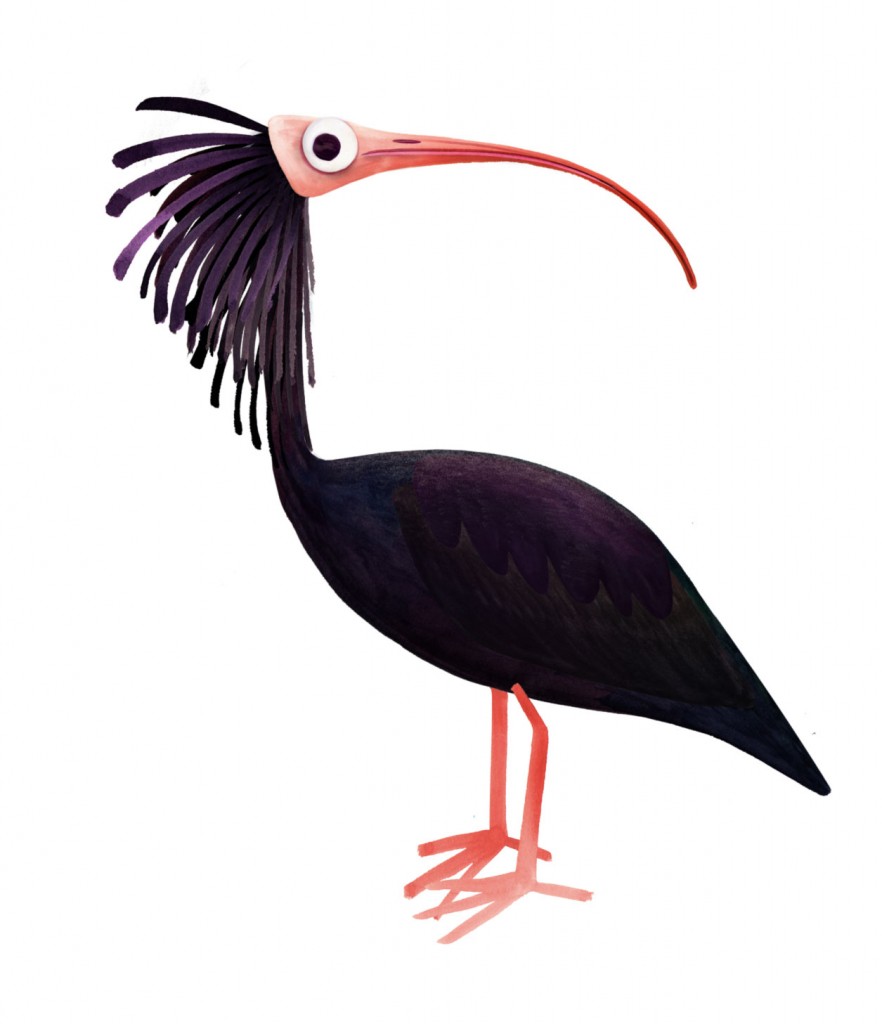
Inspiring NBI


Here we can see some drawings by Joaquín López-Rojas with a mixed technique: pen drawing and digital colour.


This Sevilla based artist has participated in many publications about nature in Spain, Venezuela and Equatorial Guinea. 

Wednesday, 7 March 2012

NBI on TV

Very recently, Northern Bald Ibis was the main character on a short documentary on Moroccan TV. It's in arabic, but if you cannot understand, images are worth to see.


Enjoy it!!

Friday, 2 March 2012

All three Syrian adults, back in Palmyra


Our colleagues in Syria just told us that all three adults, Odeinat, Salama and Zenobia, are safely back from migration on the Syrian breeding grounds today. Odeinat has been transmitting since a couple of weeks, but Salama hadn't since late last year, but this now seems to simply be tag failure rather than anything worse. 

Still no sign of the other two untagged birds that were seen on the Ethiopian wintering grounds, so where those birds go is becoming a source of speculation. 

Or perhaps they will appear at Palmyra one of these days.

From RSPB

Related Posts Plugin for WordPress, Blogger...