Sunday, 23 June 2013

NBI and people

Teo Todorov took this beautiful picture of some NBI searching for food in the southern part of Souss Massa National Park in April, 2009.


This kind of sights is easy to observe in SMNP and surroundings, where NBI frequent cultures, fallows and pasture lands, not far from people.

Saturday, 1 June 2013

Breeding finish at Tamri

Aylal has left the colony on May 15th. It has been around Tamri since the beginning of February.
It’s installed in the central part of SMNP. The colonies in the Park have still chicks due to the gap between nesting in Tamri and in Massa.

Mild winter and wet spring have probably contributed to the earlier beginning of the breeding season.

Monday, 13 May 2013

Last Northern Bald Ibis in Syria?

The events in Syria fill us with great sadness and grief. In spite of the crisis, the local team has continued to monitor the ibis, and has reported the sad news that only one of the Northern Bald Ibis has returned to the breeding site at Palmyra this spring. Unfortunately, there are no signs of any more birds so far returning from their migration to Ethiopia. The returning female Zenobia was last year paired to Odeinat, the last male, which was fitted with a small satellite tag that stopped transmitting in southern Saudi Arabia in July 2012. It has not been possible to search for Odeinat, as the last signals did not give an accurate location. Subsequently, a total of four birds was seen briefly in January this year by Yilma Abebe and Tariku Dagne (a visit supported by the Ethiopian Natural History Society and the Culture and Tourism Office of Ethiopia, with funds from RSPB) at the usual Ethiopian highland wintering site, but it now seems clear that only one of these birds has returned to the breeding area.

Last Syrian ibis among bedouin khaimahs 
(Photo M.S. Abdallah)
This looks ominously like it may be the end for the relict eastern population of the species, having been rediscovered in 2002 when there were 3 breeding pairs. Despite huge efforts the colony dwindled to just one pair in the past two years and now it seems to just the one bird. This comes at a time when coordinated efforts are strengthening and indeed after the establishment of the new International Working Group was held in Jazan, Saudi Arabia in November 2012.

Among the hopes for maintaining the eastern population are further releases from the former colony site at Birecik in SE Turkey where a semi-wild population persists.


Historical note:
Zenobia was the last empress of Palmyra, Odeinat's widow, who, after expanding his kingdom to Egypt and Anatolia, was defeated and captured by Aurelian in 272.


Sunday, 14 April 2013

Sexual dimorphism

As in most waders, sexes in NBI are similar in plumage, although males are generally larger than females. For instance, males have slightly longer wings than females (403-420 vs. 390-408 mm). As with other ibises that breed in colonies, males have also longer beaks.
Photo Brian Stone
Babbitt et al. (2007) made an analysis of sexual dimorphism in ibises. Using all 16 species for which sufficient data were available, they found that the degree of sexual dimorphism in proportional bill length was positively associated with the incidence of colonial breeding (r = 0.68, P = 0.005). On the other hand, the degree of sexual dimorphism in proportion to bill length was not significantly associated with the incidence of group foraging (r = 0.36, P = 0.18). The incidence of colonial nesting and group foraging were correlated (r = 0.55, P = 0.03) with each other, but not as strongly as the degree of sexual bill length dimorphism and colonial breeding. That means that males of gregarious breeding ibis species, like NBI, tend to have longer bills than females.
Size matters: Longer-billed males are more successful in attracting a mate.

Regarding the differences between the two populations, NBI have longer bills in Morocco than in Turkey. There's not a known reason for that, but the sexual dimorphism still exists in both populations.

Population
Male bill length
Female bill length
Morocco
141.1 mm (5.55 in)
133.5 mm (5.25 in)
Turkey
129.0 mm (5.08 in)
123.6 mm (4.87 in)

Nevertheless, the difference is very small, about 5%, to be realised in the field.


References
Babbitt, Gregory A.; Frederick & Peter C. (2007). Selection for sexual bill dimorphism in ibises: an evaluation of hypotheses. Waterbirds 30 (2): 199–206.
Siegfried, W.R. (1972). Discrete breeding and wintering areas of the Waldrapp Geronticus eremita (L.). Bulletin of the British Ornithologists' Club 92: 102–103.
Brown, L. H., Urban, E. K., & Newman, K. (1982). The birds of Africa. Vol I.

Monday, 1 April 2013

NBI and people


Northern Bald Ibis have had an important role in human culture. In addition to the religious and symbolic meaning for ancient Egyptians, in other places where it has existed has also been considered in many senses, as in Algeria. This is probably due to the behaviour of the species, which could be quite tame to people.

In Souss Massa National Park, coexistence between NBI and people has been exemplary, permiting the bird to survive in this region in spite of its extinction anywhere else.


Sidi Wassay is a village besides oued Massa stuary and was among the first to cooperate with the Park and SEO/BirdLife in the implementation of human and economical development. Thus, many women received primary education and the first group of beekeepers was also organised managing a comunal apiary sharing 40 hives (see more about this cooperation in Spanish or French)


Furthermore, Sidi Wassay is a place where NBI is quite easy to observe, due to high quality feeding grounds and its strategic situation inside the National Park. These are, maybe, the reason to choose this bird as a mascot by the Sahel Sidi Wassay Association for Cooperation and Development and the Chabab Sport Club.


On the tower of a guesthouse at Massa (photo Gianni Conca & Bruna Morandotti)

Image by Otto Kleinschmidt in 
Naturgeschichte der Vögel Mitteleuropas 
by Johann Andreas NAUMANN, 1899 
showing two NBI on a masonry wall. 
Some authors explain how the species used to nest on towers and ruins, but also that their ckicks were a delicacy for epicures. Fledglings are abundant on early representations of NBI, probably showing a familiarity to young birds kept in captivity for human consumption. 
In fact, among the first text talking about the species in early 16th century, there are several decrees punishing the capture of this species, reflecting the importance of this prosecution in Europe.
Eleazar Albin writes in the 18th century they build for the moſt part in high Walls of demoliſhed or ruinous Towers which are common in Switzerland and later The young ones are commended for good Meat and county a Dainty; their Fleſh is ſweet and their Bones tender and, later, ... deſert places; where they build in Rocks and old forſaken Towers.

Monument to kelaynak, Birecik


On the other side, the Turkish town of Bireçik held about 500 pairs by the middle of last century and reached an estimated total population of about 3,000 around 1930. NBI was higly regarded by people there, due to the myth of Noah and several religious beliefs. According to the local legend, Noah released kelaynakthe bald ibis, who leads the Ark to a place where they were established.


Old colony over Bireçik,

in the 1950s


It was also believed that the ibis migrated to the South each year to guide Hajj pilgrims to Mecca. A festival was held annually to celebrate its return north, also as a symbol of spring.
By the 1970s, the urban development and the loose of traditions led to the deterioriation of the colony and pesticides contribute to the decline.


NBI nestig besides white storks at Aït Benhaddou.
Why such  a diferent fate?


Although we don't know a particular mithological or legendary status on Northern Bald Ibis in Moroccan traditions, there are records of colonies on emblematic buildings.
There was a small colony on some ksours (adobe fortified houses) in Aït Benhaddou, as shown in the documentary French  The Oued. Those nests were apparently removed in the 1970s when the old buildings where mended for a film shooting.


Currently, the two surviving population are still quite tame. Although they seek for quite and inaccessible sites for nesting, when looking for food they are more confident. It's possible that insects are more abundant close to humane shettlements due to home refuses or livestock dung.

Sunday, 31 March 2013

Prince Albert II of Monaco Foundation renews its engagement to NBI conservation


Prince Albert II of Monaco Foundation, which is the species champion for Northern Bald Ibis, has renewed its conmitment towards the conservation of one of the most endangered birds in the world.

PA2MF has been funding mainly the wardens' expenditures (salaries and equipment), as well as other functioning costs. This is essential to the monitoring and surveillance in the colonies, and allow us to know about their behaviour, how they use their range or what are their breeding performances.

With this contribution, PA2MF is one of the most important partners for the conservation of this critically endangered species both the Moroccan and the eastern population.

Tuesday, 26 February 2013

Akh: NBI from Ancient Egypt

A couple of recent articles on NBI from Ancient Egypt, from the UCLA Encyclopedia of Egyptology.


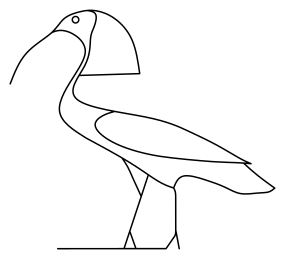
Three different kinds of ibis species are attested from ancient Egypt: the sacred ibis, the glossy ibis, and the northern bald ibis. Pictorial representations of the latter bird—easily recognizable by the shape of its body, the shorter legs, long curved beak, and the typical crest covering the back of the head—were used in writings of the noun akh and related words and notions (e.g., the blessed dead). We can deduce from modern observations that in ancient times this member of the ibis species used to dwell on rocky cliffs on the eastern bank of the Nile, that is, at the very place designated as the ideal rebirth and resurrection region (the akhet). Thus, the northern bald ibises might have been viewed as visitors and messengers from the other world—earthly manifestations of the blessed dead (the akhu). 


Janák, Jíří. (2013). Akh. UCLA Encyclopedia of Egyptology, 1(1). nelc_uee_8790. 

Saturday, 12 January 2013

NBI at Boujdour

Although young NBI records are not extremely rare in the Atlantic Sahara, specially in Boujdor, every single sighting is very important to understand the behaviour of the species.


Recently, Hugues Dufourny reported to http://www.go-south.org/ the sighting of one sub-adult bald ibis at Boujdour, on December 27th.

On the pictures (©Véronique Buchet) we can observe the kind of habitat on the coast in the region, while the dominant area is much more drier. Constant wind makes plastics fly and they stay on the browses.

In the same site web, Runar Jåbekk cited two other NBI at Boujdour in february 2012.

Every single sighting of Northern Bald Ibis outside Tamri and Souss-Massa area is extremely important to improve the knowledge on the species and improve its status. Please, share your redords with us. 

Tuesday, 1 January 2013

2012 breeding season results

2012 breeding season finished with uneven results in Souss Massa National Park and Tamri regarding breeding success.

Monitoring takes place thanks to the seven wardens that are permanently on place, supported by Prince Albert II of Monaco Foundation.

While in the protected area results were quite usual, similar to previous year, in Tamri we have recorded a failure on breeding success. Thus, in Souss-Massa 34 pairs nested (two less than in 2011) and 95 chicks hatched (one less that in 2011). 56 of them fledged (vs. 79 in 2011), thus survival was lower that last year (1,03 against 1,3). Nevertheless, at Tamri there were less pairs formed, 43 vs. 51 during the previous season. This should not be a problem, but just 11 of them lay eggs. None of them finished the incubation period.

It is not clear what the causes of the failure are, but, comparing this situation with previous years, we found that results were also bad in 2008. That year, there were 55 fledgings in Souss Massa and two in Tamri.

Although many factors could affect breeding, we found that 2008 was also a dry year; the first trimester had just 21 mm being the average for that period 99 mm. In 2012 rainfall was jus 6 mm in that period.
Related Posts Plugin for WordPress, Blogger...